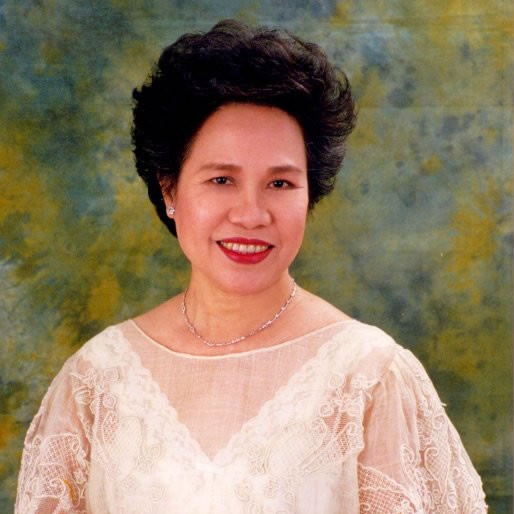
Santiago was born Miriam Palma Defensor in Iloilo City, the daughter of local judge Benjamin Defensor and college dean Dimpna Palma. She was the eldest kid in a family of seven. She was valedictorian in elementary, high, and undergraduate school. She attended Iloilo Provincial High School (now Iloilo National High School) and was the Editor-in-Chief (EIC) of the student journal "The Ilonggo" at the time of her graduation. The University of the Philippines Visayas awarded Defensor Santiago a Bachelor of Arts degree in political science, magna cum laude, in 1965. She was elected into the Pi Gamma Mu and Phi Kappa Phi honor societies after graduation.
She then went to the College of Law at the University of the Philippines. She won various oratorical and debate competitions there. She was named ROTC muse twice and became the first female editor of the student publication, The Philippine Collegian. She received her bachelor's degree in law from the University of the Philippines College of Law in Diliman.
On a fellowship to the United States, Defensor Santiago received a Master of Laws and a Doctor of Juridical Science from the University of Michigan, Ann Arbor. She completed both degrees in just over a year and a half. She went on to work as a special assistant to the Secretary of Justice after graduation. She was also a political science professor at Asia's Trinity University. She was a law professor at the University of the Philippines Diliman for ten years, teaching evening lectures.
Defensor Santiago served as Legal Officer of the UN High Commissioner for Refugees at Geneva, Switzerland. She was assigned to the Conferences and Treaties Section. She became skilled at treaty negotiation and drafting. She resigned her position when her father in the Philippines developed prostate cancer.
After martial law, in 1988, President Corazon Aquino appointed Defensor Santiago as commissioner of the Bureau of Immigration and Deportation. At that time, the BID was one of the most corrupt government agencies in Southeast Asia. Defensor Santiago declared the Philippines as "the fake passport capital of the world", and directed raids against criminal syndicates, including the Yakuza. She filled the CID detention center with alien criminals, and ordered construction of another detention center. She extended to legal aliens protection from widespread extortion by requesting President Aquino to issue an executive order that authorized the "alien legalization program".
President Corazon Aquino promoted Defensor Santiago to member of her cabinet, as Secretary of Agrarian Reform. Under a controversial law passed by Congress and signed by President Aquino, all agricultural landholdings were taken by the government and divided among the farmers. Each landowner was allowed to keep only five hectares, and each farmer received three hectares. Payment was in bonds of the Land Bank. To subvert the law, big landowners applied for conversion of the classification of their land as agricultural, to classification as commercial, residential, or industrial. The process became the widespread "conversion scandal of agrarian reform". The DAR officials themselves were the biggest culprits, because they sold conversion permits for bribes on a market rate set at certain amounts per hectare involved in the conversion. Defensor Santiago stopped the conversion scandal, and appeased the landowners by enhancing the incentives for voluntary offers by the landowners for the sale of their landholdings, which entitled them to an additional five percent cash payment. When asked if the hacienda belonging to the president's family should be covered by agrarian reform, Defensor Santiago replied that the family's hacienda should be distributed among the farmers. Shortly thereafter President Aquino accepted Defensor Santiago's resignation.
Defensor Santiago's candidacy for President of the Philippines was confirmed on 19 February 1990. She later organized the People's Reform Party (PRP) and ran with a senatorial ticket during the 1992 presidential campaign. Ramon Magsaysay Jr. was her running mate. While campaigning on 28 April 1991, she was severely injured in car crash, which she claimed was an assassination attempt. She was wearing a white bush jacket which became splattered with blood that gushed from a wound to her head. On orders of President Aquino, she was airlifted from Tarlac to a Manila hospital. She underwent surgery on the jaw, and at one point a Catholic priest administered the last rites of the dying. Two months later, she was back on the campaign trail.
Defensor Santiago was leading the canvassing of votes for the first five days. Following a string of power outages, the tabulation concluded, and Ramos was declared president-elect. Defensor Santiago filed a protest before the Supreme Court as electoral tribunal, citing the power outages during the counting of votes as evidence of massive fraud. Her election protest was eventually dismissed on a technicality.
The public outrage over the presidential results prompted Newsweek to feature her and her rival on the cover with the question: "Was the Election Fair?" In another cover story, Philippines Free Press magazine asked: "Who's the Real President?". The quote, 'Miriam won in the elections but lost in the counting' was popularized by the masses.
Senator Defensor Santiago was first elected in 1995. Fidel Ramos, her presidential competitor, launched a "people's movement" for an infinite presidential term in 1997. Defensor Santiago slammed Ramos' campaign and took him to court. Defensor Santiago versus COMELEC was a landmark lawsuit in which she won and upheld the people's mandate for term limits. In the 1998 presidential elections, she campaigned for president again with Francisco Tatad, but was defeated due to massive propaganda about her mental health, which was later revealed to be incorrect.
Defensor Santiago was elected to the International Criminal Court (ICC) as a judge in 2011, hearing trials against former heads of state for crimes against humanity. She was the first Asian woman from a third-world country to hold such a position. Following a lung cancer diagnosis, she resigned in 2014. During his impeachment trial, she was one of three senators who voted against Supreme Court Chief Justice Renato Corona's conviction; he was found guilty for failing to reveal his statement of assets, liabilities, and net worth to the public.
She revealed in December 2012 that Senate President Juan Ponce Enrile had given away Senate funds as cash gifts. Except for Defensor Santiago and two others, every senator received $2 million, despite the fact that a large portion of the Filipino populace was poor. As a result of the controversy involving the Priority Development Assistance Fund, the Senate president was charged with plunder and imprisoned. The public outcry and support for Defensor Santiago's request to eliminate the pork barrel system grew as a result of his live Senate hearings in the case.
In 2016, she became the first Filipino to be elected to the International Development Law Organization (IDLO) as a commissioner. Her duty in the organization was to provide legal advice to the international community.
Among the laws that Defensor Santiago authored are:
After physicians in the United States declared her cancer to be "stable" and "receding," Defensor Santiago announced her desire to compete in the 2016 Philippine presidential election in October 2015. Senator Bongbong Marcos, she later confirmed, would be her vice presidential running mate. Her social media-driven campaign centered on the young sector, which she strongly supported. In multiple polls held at public and private institutions and colleges across the country, she came out on top by a wide margin. Regardless, she came up short in the elections. Following her presidential campaign, Defensor Santiago was dubbed "The Greatest President we never had," a moniker she had previously earned. Youth for Miriam, a youth group that backed her during the campaign, renamed itself Youth Reform Movement and established a separate organization based on her works and literature.
Various groups in the country praised her for running for the Secretary-General position of the Association of Southeast Asian Nations, where the chosen Secretary-General will be positioned for 2018. AirAsia CEO Tony Fernandes of Malaysia and an unnamed official from Brunei, which is the lead country for 2018–2022, are among the other applicants for the role.
In September 2016, the University of the Philippines named her a "Distinguished Icon of Legal Excellence and Public Service," and the Polytechnic University of the Philippines awarded her the "PUP Online Personality of the Year Award" posthumously in November 2016.
Defensor Santiago died in her sleep at 8:52 a.m. at the age of 71. Defensor Santiago died in her home in La Vista Subdivision, Quezon City, on September 29, 2016, while she was confined to the St. Luke's Medical Center in Taguig due to lung cancer, according to multiple reports. Santiago's final words, according to her husband, were "I accept this. I do not want to do anything heroic," and her final wish was to be remembered simply by her family. The following day, her remains was laid in state at the Cathedral Grottos of the Immaculate Conception Cathedral in Cubao.
On October 2, she was laid to rest beside her son Alexander, who died in 2003, in the Loyola Memorial Park in Marikina, following a Catholic funeral Mass. Iloilo City, Santiago's hometown, announced a day of mourning for her and flew the Philippine flag at half-mast from September 29 to October 17, 2016. Defensor Santiago, according to the local authorities, "gave pride and glory to all Ilonggos."